
Automation creates value in hotels when it removes repetitive friction, improves decision visibility, or expands service capacity without weakening guest choice or worker judgment. Operators should evaluate technology by task, workflow, data quality, reliability, labor impact, and recovery design rather than by the promise of replacing headcount.
TL;DR Automate the task before you automate the role. Map the current workflow, identify where standardization is safe, involve frontline employees in design, preserve human escalation for exceptions, measure service and labor outcomes together, and plan for system failure as part of normal operations.
The useful unit of automation is the task
Hotel jobs combine routine transactions with physical work, judgment, empathy, exception handling, and coordination across systems. A technology may automate pre-arrival messages, room-assignment rules, invoice delivery, work-order routing, forecasting, or basic guest questions while leaving the rest of a role intact. Operators get a clearer business case when they identify the task, its frequency, current error rate, service impact, labor minutes, and exception rate before choosing a tool.
The AHLA AI for Hospitality whitepaper frames AI across operational efficiency, guest experience, analytics, customer service, and revenue use cases. The operator challenge is to convert broad possibilities into a small number of workflows with measurable ownership.
Frontline knowledge should shape implementation
Worker participation is especially relevant when technology changes how work is sequenced or monitored. A 2026 ILO-hosted presentation on AI and automation in hospitality work describes research with hotel workers and highlights how design and implementation choices can affect transparency, autonomy, and worker judgment. Operators should treat that as a governance signal: employees who perform the task often know the exceptions and dependencies that a central process map misses.
Involving staff early can reveal whether the automation removes waste or merely moves work into hidden manual recovery. It can also identify training needs and unintended pressure created by new performance metrics.
Guest self-service should add control, not remove support
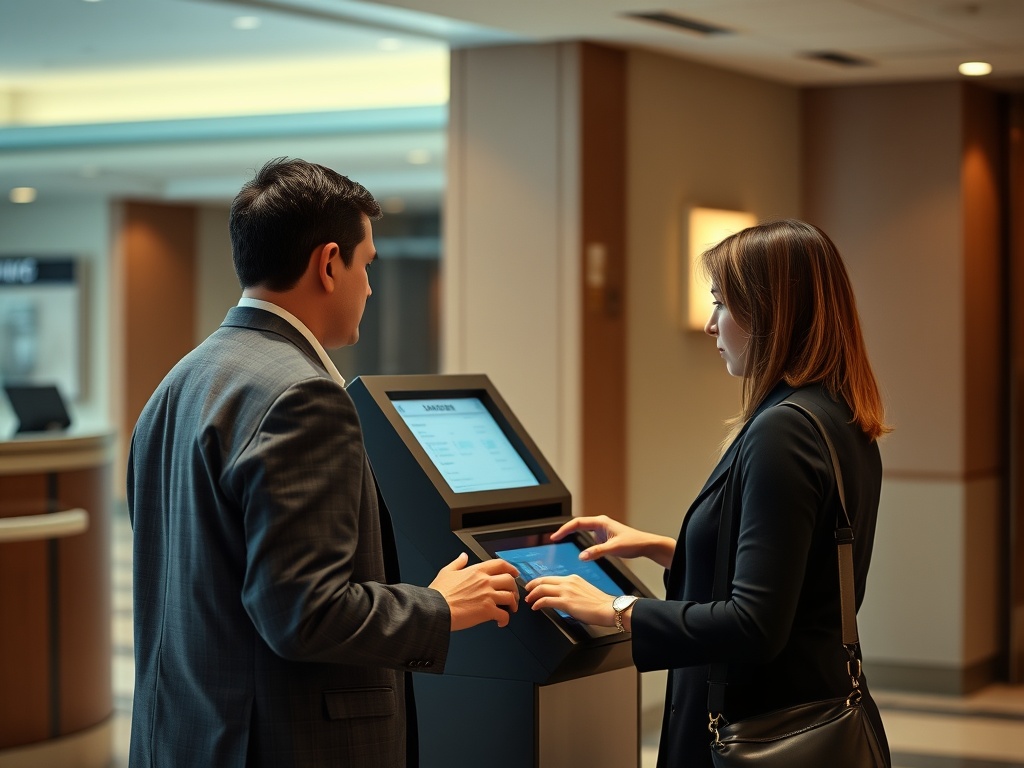
Mobile check-in, digital keys, kiosks, chat, automated upsells, and messaging can reduce waiting for guests who prefer self-service. The same tools can frustrate travelers when identity verification fails, accessibility needs are not supported, or the system cannot interpret a complex request. The best design offers a clear path from automation to a person without forcing the guest to restart the interaction.
Operators should measure containment alongside recovery quality. A high percentage of automated interactions is not a success if unresolved issues reappear at the front desk with less context and more frustration.
Labor savings should be tested against new work created by the system
Technology can reduce manual entry, repetitive questions, and scheduling effort, but it also creates configuration, monitoring, exception handling, training, vendor management, privacy review, and outage recovery. The business case should include those tasks. A system that saves ten minutes in one department and creates fifteen minutes of correction elsewhere has automated the wrong boundary.
This is why automation belongs in total revenue management conversations as well as IT planning. Labor capacity is a constrained resource, and automation can change how much demand an outlet or service team can handle. The value may appear as better capacity, fewer errors, more consistent service, or improved decision speed rather than immediate headcount reduction.
Data quality sets the ceiling on intelligent automation
AI-assisted recommendations and workflow rules depend on the inputs they receive. Duplicate guest profiles, stale room attributes, inconsistent market segments, missing maintenance status, or unreliable inventory feeds can turn a sophisticated model into a faster source of mistakes. Operators should define authoritative systems, data ownership, update frequency, and exception rules before scaling automated decisions.
The issue is visible in distribution as well. AHLA’s current AI community and distribution-readiness work focuses on technology, data readiness, governance, integration, and emerging AI-driven channels. For hotels, readiness is less about owning an AI label and more about whether the underlying content and operational data are structured enough to be trusted.
Every automated workflow needs a failure mode
Hotels operate continuously, so downtime design matters. Teams need to know what happens when a key encoder, messaging platform, payment service, property system integration, scheduling tool, or AI service is unavailable. Which tasks can continue manually? What data will be lost? Who can override a rule? How are guests informed? When does the hotel stop accepting an automated promise it may not be able to fulfill?
A manual fallback should be practiced, not merely documented. The more central the automation becomes, the more important it is to test degraded operation.
Automation changes the service model and therefore the positioning
A highly automated experience may fit a property positioned around speed, independence, or digital convenience, while a high-touch hotel may use automation mainly behind the scenes so staff can spend more time with guests. That strategic choice should be connected to property positioning rather than made by the technology team alone.
It also affects next-generation traveler segment strategy. Preferences for self-service vary by task and situation, so operators should test behavior instead of assigning one automation preference to an entire age group or traveler label.
Do not let automation metrics become the goal
Measures such as chatbot containment, kiosk adoption, automated task completion, or reduced manual touches can be useful, but they are intermediate indicators. The property still needs to watch guest resolution, staff workload, error recurrence, revenue impact where relevant, and service recovery. Optimizing for automation usage alone can push teams to keep interactions automated even when a human handoff would produce a better outcome.
Set governance before the pilot becomes infrastructure
Small technology pilots can become operationally critical faster than governance catches up. Before scaling, operators should define who can change rules or prompts, who reviews outputs, which data the system may access, how vendors are evaluated, how incidents are logged, and who has authority to disable the automation. These decisions matter especially when the tool influences pricing, room assignment, employee work sequencing, or guest communications.
A review cadence should also match the risk. A low-consequence internal drafting assistant may need light oversight, while a system that makes guest-facing commitments or affects employee workload needs more frequent performance, bias, privacy, and reliability checks. Governance should be proportionate to the consequence of a wrong answer or failed workflow.
Treat training time as part of the investment
Automation changes procedures even when the interface looks simple. Budget time for frontline training, supervisor coaching, exception practice, new-hire onboarding, and refresher sessions after system updates. If training is treated as a one-time launch task, staff may create unofficial workarounds that weaken data quality or guest consistency. The labor case should therefore include the ongoing effort required to keep the automated workflow usable and trusted.
A disciplined pilot makes the labor story credible
Choose one workflow with a defined baseline, involve the employees who perform it, and record both service and labor measures before launch. After implementation, compare handling time, error rate, escalation rate, guest friction, staff workload, and system-maintenance effort. Include qualitative feedback, but distinguish it from measured outcomes. If the tool changes the work in an unexpected way, redesign the process before scaling.
The next step is to inventory the property’s current automations and score each on guest value, employee value, data reliability, exception burden, and fallback readiness. The scorecard will usually reveal a more useful priority list than a broad mandate to 'use more AI.'