Ornamental grasses and flowering perennials work best together when they share similar light, soil, and moisture needs and are arranged by mature size, seasonal timing, and growth habit. Grasses can add movement, fine texture, seed heads, and winter structure, while perennials bring concentrated flower color and broader foliage forms.
TL;DR: Match plants to the site first. Choose one or two structural grasses, repeat a limited palette of perennials around them, vary heights without creating a staircase, leave enough space for mature spread, and plan for spring, summer, fall, and winter interest. Use native or regionally appropriate species where they fit the design and growing conditions.
Start With Site Conditions, Not a Plant List
The most attractive pairing will fail if the plants need different conditions. Record how many hours of direct sun the bed receives, whether soil stays dry or moist, how quickly water drains after rain, and how much irrigation is available. Check local hardiness and regional suitability before choosing species.
Colorado State University Extension’s ornamental grass guidance emphasizes the wide range of grass heights, textures, soil preferences, and water needs. Iowa State University Extension similarly notes that ornamental grasses vary in size, moisture preference, sun tolerance, and landscape use.
Do not assume “grass” means drought tolerant or full sun. Some grasses prefer moist soil or partial shade, while certain perennials thrive in dry conditions. Build the palette around compatible groups.
Give Each Plant a Design Job
Choose Grasses by Mature Size
A grass that looks modest in a nursery pot can become much larger after establishment. Read mature height and spread information before planting. Tall switchgrass, big bluestem, miscanthus, or feather reed grass can overwhelm a small front border if placed too close to a path or window. Compact sedges, blue fescue, prairie dropseed, and other smaller grasses may fit tighter spaces better, depending on region and site.
Growth habit matters too. Clump-forming grasses tend to stay in a defined crown, while some species spread by rhizomes or seed more freely. A plant that is well behaved in one climate can be aggressive or invasive in another. Check regional invasive-species guidance before planting ornamental grasses that have a history of escaping cultivation.
If you are planning the whole yard for simpler upkeep, pair this plant-selection step with broader area and layout decisions indoors and functional zoning outdoors. The same design discipline applies: measure the mature footprint before filling the space.
Pair Textures Instead of Matching Everything
Grasses are especially useful because their narrow blades contrast with many perennial leaf shapes. A fine grass beside broad hosta-like leaves creates a stronger textural difference than two plants with similar narrow foliage. Upright grass stems can also balance mounded plants that spread horizontally.
Plan a Seasonal Sequence
Many ornamental grasses become most visually prominent from midsummer through winter. That makes them useful partners for spring bulbs and early perennials that fade before the grasses reach full size.
Iowa State Extension notes that grasses can pair well with spring bulbs because the grass foliage emerges later and can help mask declining bulb foliage. In summer, flowering perennials can dominate while grasses build mass. In fall, seed heads and changing grass color can take over as some flowers fade. Standing grass stems can add winter structure where local conditions and maintenance practices allow.
Build a simple seasonal chart before planting. List what provides interest in early spring, late spring, summer, fall, and winter. You do not need bloom in every week. Aim for a sequence in which the bed always has at least one strong feature.
Use Height in Layers Without Making a Staircase
The old formula of short plants in front, medium plants in the middle, and tall plants in back is useful for visibility but can look rigid. A more natural design allows a few taller grasses to move forward, while lower perennials repeat behind or around them.
A Simple Pairing Framework
| Garden condition | Grass role | Perennial partner qualities |
|---|---|---|
| Sunny and dry | Fine or upright drought-adapted grass | Drought-tolerant flowers with contrasting leaf shape |
| Sunny and average moisture | Mid-height clumping grass | Long-blooming perennials and spring bulbs |
| Moist sunny bed | Moisture-tolerant structural grass | Perennials that also accept consistent moisture |
| Part shade | Shade-tolerant sedge or grass-like plant | Woodland perennials with broad leaves or spring flowers |
| Pollinator-focused planting | Native grass with seed and habitat value | Regionally native flowering perennials with staggered bloom |
This is a design framework, not a universal plant list. Species and cultivars should be selected for the climate, soil, available water, and local ecological concerns.
Step-by-Step Planting Process
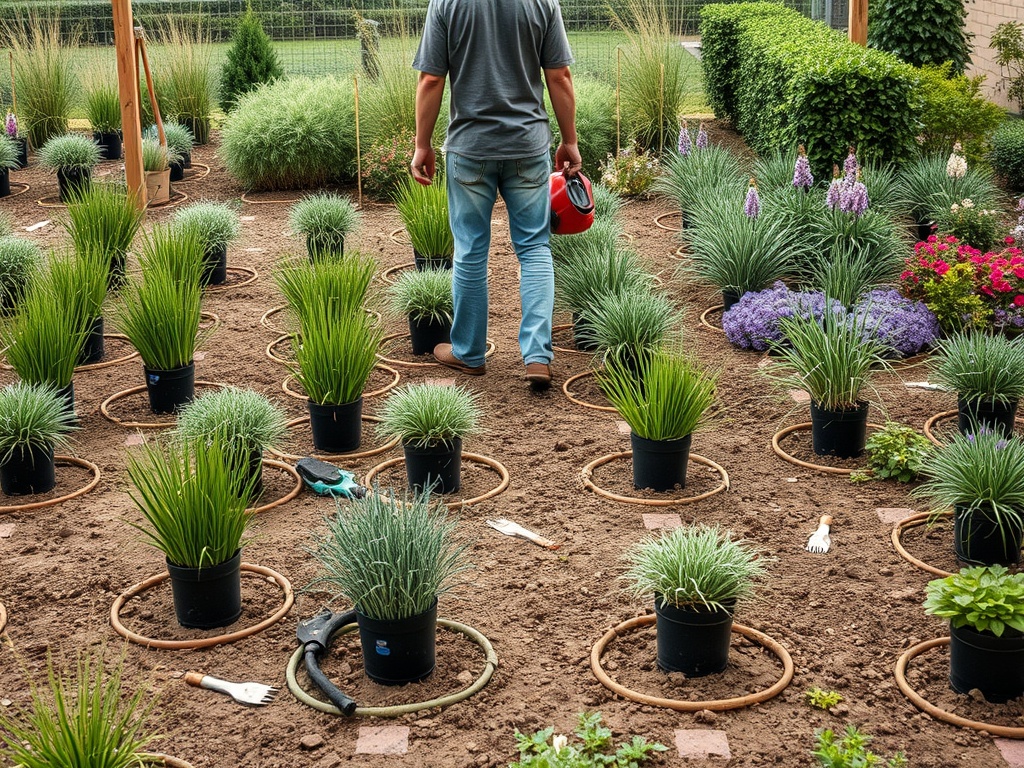
1. Mark mature footprints
Use stakes, pots, or circles of hose to represent mature width, not nursery-pot size. Walk the path and check sightlines from windows, doors, patios, and neighboring properties.
2. Place the structural grasses first
Set the largest or most visually important grasses in place. Repeat them if the bed is large enough. Avoid one of every grass simply because each is attractive individually.
3. Add perennial groups
Place perennials in groups or repeated drifts sized to the bed. Mix bloom times and leaf forms while keeping water and light needs compatible.
4. Fill seasonal gaps
Add bulbs, late-blooming flowers, or low ground-covering plants only where they solve a real gap. Do not fill every inch immediately; plants need room to mature.
5. Plant at proper depth
Follow species and nursery instructions. In general, set container-grown plants at the same soil level they occupied in the pot unless reliable plant-specific guidance says otherwise. Water the root zone after planting and monitor moisture during establishment.
Maintenance Through the Year
Newly planted grasses and perennials need more consistent watering during establishment than mature plants with developed root systems. Mulch can help moderate soil moisture and suppress weeds, but keep it away from crowns and stems where excessive moisture can cause problems.
Divide grasses and perennials when they become overcrowded, lose vigor in the center, or exceed the design footprint, using species-appropriate timing. Do not divide every plant on the same calendar just for consistency.
If the bed includes low-voltage or line-voltage lighting, keep fixtures accessible and avoid letting mature foliage bury wiring or create unsafe heat conditions. The guide to automating outdoor lighting efficiently explains how zoning and control can support a landscape without leaving every light on all night.
Common Pairing Mistakes
- Ignoring mature spread: Small nursery pots can become large clumps.
- Mixing incompatible water needs: One irrigation routine cannot satisfy every plant.
- Using too many one-off specimens: Repetition usually creates stronger unity.
- Choosing only for flowers: Foliage, seed heads, form, and winter structure matter too.
- Planting aggressive spreaders casually: Check regional behavior and invasive status.
- Cutting everything down in fall automatically: Some grasses provide winter interest and habitat, though local conditions can change the best practice.
- Putting tall grasses beside narrow paths: Mature leaves and seed heads can lean into circulation space.
Seasonal cleanup can also be coordinated with decor and storage rotation so outdoor containers, tools, and cut decorative stems do not become mixed with indoor storage systems.
Design for Movement Across the Seasons
A strong grass-and-perennial bed is built around compatibility first and appearance second. Match light, soil, moisture, and mature size; then use grasses for structure, movement, and late-season interest while perennials provide changing color and broader leaf forms. Repeat a restrained palette and leave room for growth. The result should become more coherent as plants mature rather than more crowded every year.
This landscaping and gardening content is for informational and educational purposes only. Plant suitability, hardiness, invasiveness, irrigation needs, wildfire guidance, and maintenance timing vary by region. Consult local extension, botanical garden, or qualified horticultural professionals for site-specific advice.[/