
Quartz, granite, and butcher block can all work well in a kitchen, but they suit different priorities. Engineered quartz is usually the easiest choice for consistent appearance and routine care, granite appeals to homeowners who want natural stone variation and can follow stone-specific maintenance, and butcher block offers warmth and repairability but needs the most attention around water, cuts, heat, and finish upkeep.
TL;DR: Choose quartz for lower routine maintenance and consistent patterns, granite for natural-stone character and heat-resistant mineral surfaces with stone-specific care, and butcher block for a warm wood surface you are willing to maintain. Installation quality, finish, edge details, sink cutouts, and how you actually cook matter as much as the headline material.
Compare the Materials by Daily Habits
The right countertop is not simply the hardest or most expensive option. Think about what happens on the surface every day. Do you leave wet dishes near the sink? Put hot cookware down quickly? Bake and roll dough? Use strong cleaners? Want a surface that can be refinished after wear? Prefer natural variation or a controlled pattern?
A comparison is most useful when it separates material properties from preferences. Natural stone varies slab to slab. Engineered quartz varies by manufacturer and product line. Butcher block varies by wood species, construction, thickness, and finish. Treat broad category statements as starting points and verify the exact product before purchase.
If your kitchen project also includes storage, the guide to drawer organizers for kitchens and bathrooms can help match the countertop decision with how knives, utensils, and prep tools will be stored.
Quick Comparison
| Factor | Quartz | Granite | Butcher block |
|---|---|---|---|
| Appearance | Consistent to stone-like patterns | Natural slab variation | Warm natural wood grain |
| Routine cleaning | Generally simple with mild cleaners | Mild, stone-appropriate care | Finish-dependent; avoid prolonged moisture |
| Sealing | Often does not require stone sealer | May require sealing depending on stone and finish | Oiled or unfinished surfaces need periodic conditioning; sealed tops follow finish instructions |
| Heat | Use trivets; resin content can be heat-sensitive | Mineral surface generally handles heat better, but thermal shock and sealers still matter | Protect from hot cookware and scorching |
| Scratches/cuts | Resistant but not a cutting board | Resistant but can dull knives and chip at edges | Can show cuts; some surfaces can be sanded/refinished |
| Water exposure | Nonporous engineered surface | Stone porosity varies | Wood movement and finish damage are concerns |
| Pattern consistency | High | Low to moderate | Natural grain variation |
| Repair approach | Product-specific professional repair | Stone repair may be possible | Sanding/refinishing may be possible depending on construction and finish |
Quartz: Best for Predictable Appearance and Easy Routine Care
Quartz countertops are engineered surfaces made with mineral content and binders. Their biggest practical advantages are consistency and low day-to-day maintenance. Many products are nonporous, so routine cleaning does not involve sealing the way some natural stones do.
Manufacturer guidance matters. Caesarstone’s quartz care instructions recommend mild cleaning, prompt spill removal, protection from high heat with trivets or hot pads, and caution with strong chemicals. Other brands can have different formulations and approved cleaners, so use the care instructions for the product you buy.
Quartz is a strong choice when you want a controlled color or pattern across several countertop runs. It can imitate stone, concrete, or other looks while avoiding the exact slab-to-slab variation found in granite. That predictability is a design preference, not automatically a quality advantage.
Quartz trade-offs
Granite: Best for Natural Variation and Stone Character
Granite is a natural igneous stone cut into slabs, so color, mineral pattern, fissures, and movement vary. Homeowners who value unique natural material often see that variation as the main appeal. Others may prefer quartz precisely because it is more consistent.
Granite care depends on the individual stone, finish, installation, and sealer. The Natural Stone Institute’s care guidance explains that stone composition affects which cleaners are appropriate and emphasizes using products compatible with the stone. Some granite may benefit from sealing, while the need and frequency should be based on the actual material rather than a universal calendar rule.
Granite tolerates everyday kitchen use well when properly fabricated and maintained, but it is not immune to chips, stains, cracks, or thermal stress. Edges and sink cutouts are common vulnerable points, so fabrication and installation quality are important.
Granite trade-offs
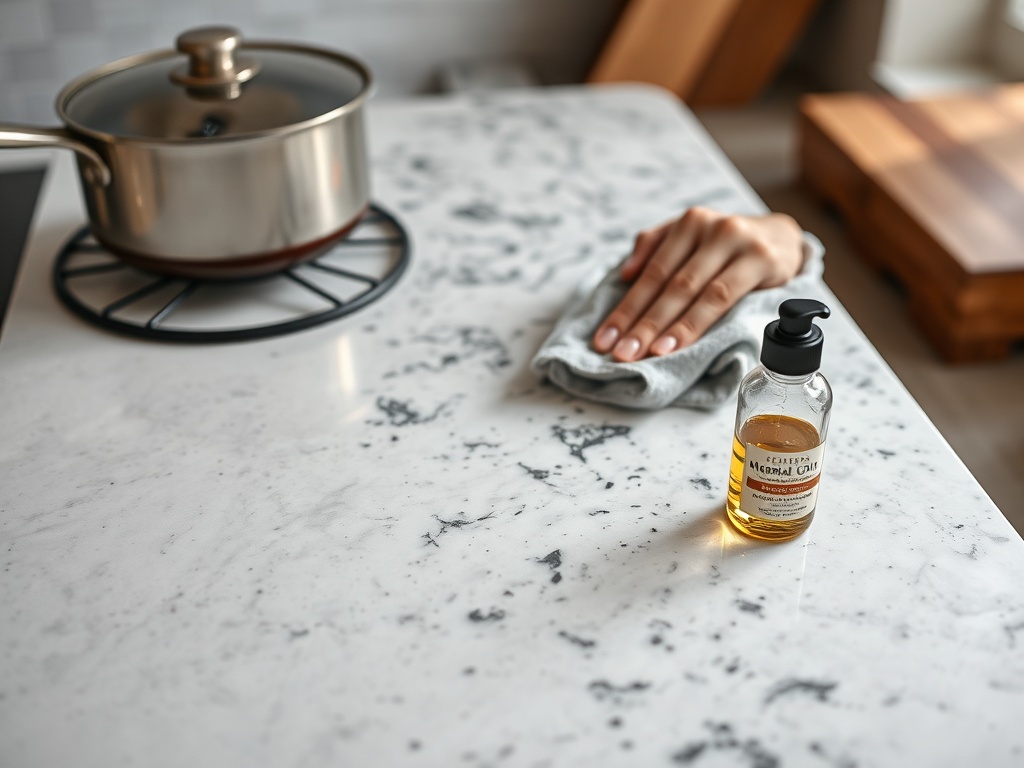
Butcher Block: Best for Warmth and a Repairable Wood Surface
Butcher block brings a material quality that stone and engineered surfaces cannot duplicate: warm grain, tactile softness, and the ability to age visibly. It can work as a full countertop or as an island, baking zone, or accent surface.
Its maintenance depends heavily on finish. An oiled food-preparation surface behaves differently from a film-finished decorative countertop. Wood can absorb moisture, swell, shrink, stain, scorch, and develop knife marks. Some of those marks can be sanded out, but repeated refinishing also changes the surface over time.
Food safety should be treated separately from appearance. USDA Food Safety and Inspection Service guidance on cutting boards states that consumers can use wood or nonporous cutting surfaces and emphasizes cleaning, sanitation where appropriate, and replacing boards that become excessively worn or develop hard-to-clean grooves. A countertop finish may not be intended for direct cutting, so follow the countertop manufacturer’s instructions.
Butcher-block trade-offs
Water around sinks is the biggest practical concern. Standing moisture can damage finishes and contribute to movement or discoloration. Hot pans can scorch. Knives can leave visible cuts. On the other hand, a surface intended to be renewed may allow sanding and refinishing that would not be possible on engineered stone.
Cost: Compare the Installed System, Not the Slab Alone
Countertop prices vary too widely by region, thickness, grade, brand, slab yield, edge profile, sink cutouts, backsplash details, demolition, reinforcement, and installation to give a single reliable number without local quotes. Butcher block can be economical in some configurations and premium in others. Quartz ranges from entry-level lines to high-end designs. Granite can range from common stones to rare slabs with expensive fabrication.
Maintenance Differences in Real Life
Quartz
Wipe spills promptly, use mild nonabrasive cleaners unless the manufacturer approves something stronger, protect from high heat, and avoid using the counter as a cutting board. Check the exact product’s warranty and care guide.
Granite
Use stone-compatible cleaners, wipe acidic or oily spills promptly, and determine sealing needs based on the specific stone and installer or manufacturer guidance. Avoid assuming that every granite slab behaves identically.
Butcher block
Keep standing water under control, protect from heat, clean according to the finish, and renew oil or finish only with products appropriate to that surface. Pay extra attention to sink cutouts and end grain where moisture can enter.
Choose by Kitchen Personality
Choose quartz if you want predictable color, broad design choices, and simple routine care, and you are comfortable using trivets and cutting boards.
Choose granite if natural variation is a feature for you, you want genuine stone, and you are willing to use stone-specific cleaners and follow sealing guidance for the slab.
Choose butcher block if warmth, tactile wood, and the possibility of refinishing are important, and you accept more active moisture and finish maintenance.
Choose the Surface That Fits Your Habits
There is no objective winner across quartz, granite, and butcher block. Quartz is often the lower-maintenance engineered option, granite offers unique natural stone, and butcher block provides warmth with higher upkeep. Compare the exact product, finish, installer, warranty, and care instructions, then choose the surface whose trade-offs align with how your household cooks and cleans. For adjacent living areas, review area rug sizing separately so surface choices remain room-specific.
This countertop comparison is for informational and educational purposes only. Product composition, fabrication, food-contact suitability, structural support, installation requirements, warranties, and local building rules vary. Consult manufacturers and qualified installers for project-specific guidance.[/